Most waste routes don’t become inefficient overnight. They drift.
A new subdivision gets added. A commercial stop changes frequency. A driver knows a shortcut that never gets documented. A holiday adjustment stays in place longer than it should. Over time, routes that once made sense start carrying hidden inefficiencies: extra miles, unbalanced workloads, missed stops, unnecessary go-backs, and long days for some drivers while others finish early.
That’s why route optimization has become such an important conversation for waste and recycling operations. But in the real world, optimization is not just about drawing the shortest line on a map. For haulers and municipalities, the bigger challenge is building routes that can actually be executed, tracked, adjusted, and improved over time.
That’s where Hauler Hero helps waste teams move from paper-based route management to a more connected, digital operation.
What Route Optimization Really Means in Waste Operations
Route optimization in waste and recycling is more complex than simple navigation.
A waste route has to account for:
- Stop density
- Service frequency
- Container size and material type
- Disposal site trips
- Driver and vehicle assignments
- Customer notes and access instructions
- Exceptions such as blocked containers, not-outs, or contamination
- Recurring routes and on-demand work orders
A route can look efficient on paper but still break down in the field if drivers don’t have the right information, dispatch can’t see progress, or the office can’t connect service outcomes to billing and customer support.
That’s why modern route optimization starts with visibility and execution.
The First Step: Digitizing Route Operations
Before a route can be improved, it needs to be clearly documented.
Many haulers still rely on a mix of paper route sheets, driver memory, spreadsheets, and manual dispatch updates. That creates risk. If a long-time driver leaves, gets sick, or switches routes, valuable operational knowledge can disappear with them.
Hauler Hero helps bring routes into a digital system where dispatchers can manage recurring work, on-request jobs, stop details, service notes, and driver assignments in a more structured way.
Instead of relying on disconnected tools, teams can operate from a single source of truth.
Route Management vs. Route Optimization
It’s important to be precise: Hauler Hero is focused on route management, dispatch, execution, and operational visibility. We are currently working on an AI powered solution based on a combination of historic data + human input as we believe that know one understands the streets better than the ones that drive them.
But for many waste operations, the biggest efficiency gains do not start with a complex optimization model. They start with fixing the daily execution gaps that cause routes to fall apart:
- Paper route sheets
- Unclear service instructions
- Dispatchers chasing drivers for updates
- Missed service documentation
- Billing disconnected from completed work
- No easy way to see where exceptions are happening
Hauler Hero helps solve those problems by giving teams better control over how routes are dispatched, completed, tracked, and reviewed.
How Hauler Hero Supports Smarter Route Operations
1. Digital Dispatch to Driver Tablets
Drivers need clear, usable information in the cab.
With Hauler Hero, routes and work orders can be dispatched digitally to driver tablets. Drivers can see stop details, service information, notes, and actions needed for each stop.
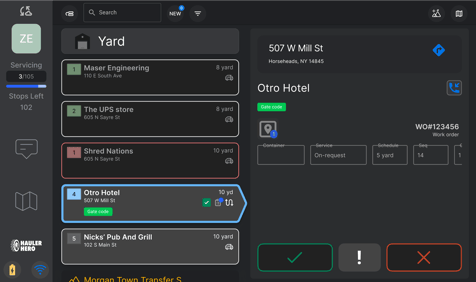
That reduces reliance on paper, phone calls, and handwritten instructions. It also helps make route knowledge more consistent across the team.
2. Real-Time Route Visibility
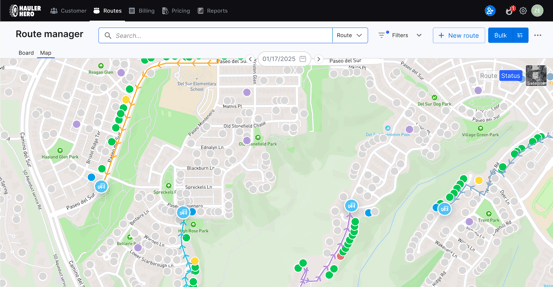
Dispatchers and supervisors need to know what is happening while routes are still in progress, not after trucks return to the yard.
Hauler Hero gives operations teams visibility into route progress and service activity throughout the day. This helps teams identify issues earlier, respond to route changes, and reduce end-of-day surprises.
When a customer calls asking about service, the office can look at the system instead of chasing down a driver.
3. Exception Tracking and Proof of Service
Waste routes rarely go exactly as planned. Containers are blocked. Carts are not out. Gates are locked. Customers dispute service. Weather and traffic create delays.
Hauler Hero helps drivers capture service outcomes and exceptions digitally, including notes and service documentation. This gives the office a clearer record of what happened at the stop. Hero Vision, our AI powered solution, helps waste management companies leverage AI to provide proof of service. Using cameras in the track our AI systems can match different exceptions and provide a digital proof for service verification.
That matters because proof of service is not just an operational tool. It helps reduce disputes, support customer service, and protect revenue.
4. Better Coordination Between Dispatch, Billing, and Customer Service
Route execution does not happen in isolation.
If a service was completed, missed, rescheduled, or billed incorrectly, multiple teams may be affected. Dispatch, customer service, and billing all need access to accurate service records.
Hauler Hero connects operational workflows with billing and customer information, helping teams reduce duplicate entry and avoid disconnected follow-up work.
This is especially important for haulers managing recurring service, one-time charges, disposal tickets, late fees, and customer-specific billing rules.
5. Reporting That Helps Teams Improve Over Time
Route optimization should not be a one-time project. Routes change constantly as customers, service areas, and operational demands evolve.
Hauler Hero reporting helps teams review route activity, service outcomes, exceptions, and operational trends. That visibility helps managers ask better questions:
- Which routes generate the most exceptions?
- Where are repeat service issues happening?
- Which areas are creating the most go-backs?
- Are certain routes consistently harder to complete?
- Are service changes making their way into billing correctly?
The goal is not just to collect data. The goal is to use that data to make better operational decisions.
What Happens When Routes Are Managed Better
When routes are digitized and execution becomes more visible, waste operations can improve in practical ways:
- Fewer missed pickups
- Less time spent chasing driver updates
- Cleaner communication between dispatch and the field
- Better service documentation
- Faster customer service responses
- More accurate billing
- Better visibility into route performance
- Less dependence on paper and institutional memory
These improvements compound over time. A few minutes saved per route, fewer go-backs per week, and less admin work per billing cycle can make a meaningful difference.
Best Practices for Smarter Waste Route Operations
Start With Real Route Data
Before improving routes, capture how your operation actually works today. That includes service addresses, frequencies, container details, customer notes, route assignments, disposal locations, and common exception types.
Routes built on assumptions often fail in the field. Routes built on real operational data are much easier to manage and improve.
Involve Drivers and Dispatchers
Drivers know the route details that do not always show up in a system: tight turns, locked gates, bad access windows, difficult containers, and recurring problem stops.
Dispatchers know where daily friction happens. Customer service knows where complaints repeat.
A strong route improvement process includes all of those perspectives.
Treat Route Improvement as Ongoing
Routes should not be reviewed once and forgotten.
Every new account, service change, disposal site adjustment, or staffing change can affect route performance. A digital system makes it easier to keep routes current instead of letting inefficiency build quietly over time.
Connect Route Execution to Billing
If service happens in the field but does not flow cleanly into billing, revenue can be missed.
Strong route operations should connect completed work, exceptions, work orders, disposal tickets, and billing workflows as closely as possible. This helps reduce leakage and improves cash flow.
Choosing the Right Route Technology for Waste Operations
When evaluating route optimization or route management software, waste operators should look beyond the map.
The right system should help your team:
- Manage recurring and on-demand routes
- Dispatch work digitally to drivers
- Capture service outcomes and exceptions
- Give dispatch visibility into route progress
- Support customer service with accurate service records
- Connect operations to billing
- Provide reporting that helps improve performance over time
- Be simple enough for drivers and dispatchers to actually use
A route plan only creates value if the team can execute it.
Final Thoughts
Route optimization in waste and recycling is not just about finding the fastest path. It is about creating a more reliable, visible, and adaptable operation.
Hauler Hero helps waste teams digitize route workflows, dispatch work to tablets, capture service activity, reduce manual follow-up, and use operational data to improve over time.
For haulers and municipalities looking to modernize, the first step is not always a complete route redesign. Sometimes the most important step is making sure the routes you already run are visible, manageable, and connected to the rest of your business.